

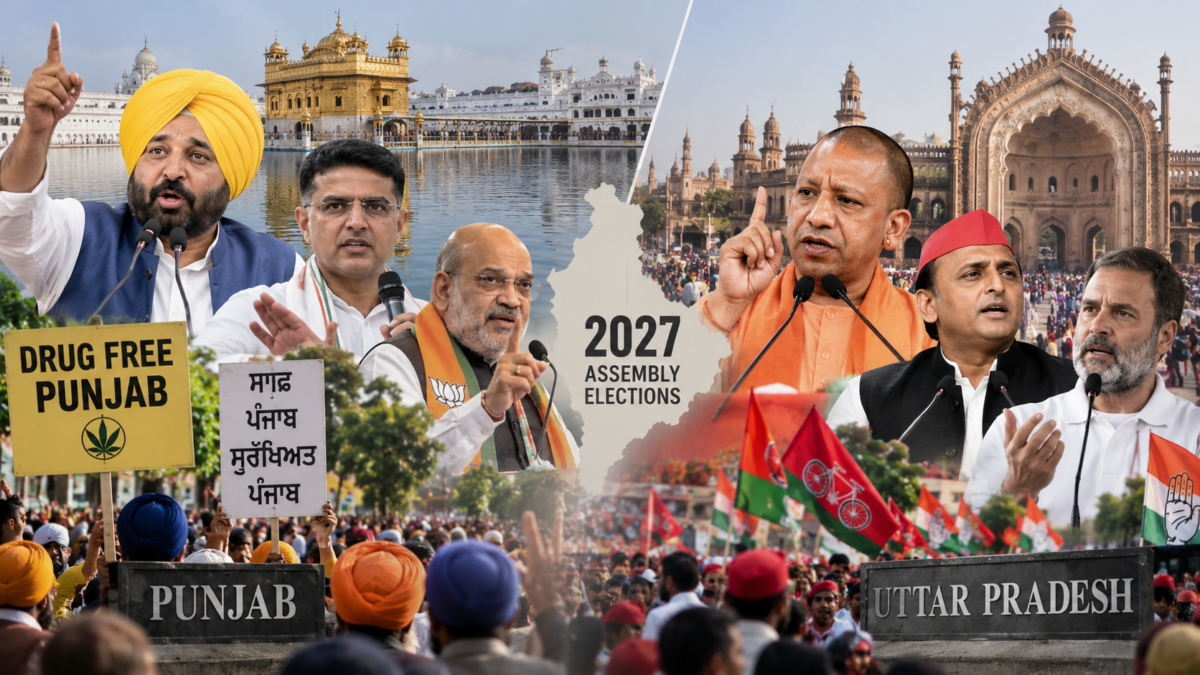
New Delhi: Political activity is picking up in Punjab and Uttar Pradesh as both states move towards their 2027 Assembly elections. With the polls still several months away, major political parties have already started strengthening their organisations, expanding grassroots outreach and focusing on issues expected to shape the electoral debate.
In Punjab, the ruling Aam Aadmi Party (AAP) is preparing a statewide door-to-door campaign beginning September 20, while the Bharatiya Janata Party (BJP) has launched a 4,000-km Nasha Mukt Punjab Yatra covering all 117 Assembly constituencies. The Congress, meanwhile, has appointed Sachin Pilot as its Punjab in-charge and is working to organise its state unit ahead of the election.
In Uttar Pradesh, political parties are similarly concentrating on their organisational structures, grassroots networks and voter outreach. The Congress has made a fresh organisational appointment in the state, while discussions between the Samajwadi Party (SP) and Congress over seat-sharing for the 2027 election remain unresolved, according to recent reports.
With both states expected to witness an intense political campaign, issues ranging from government performance and public welfare to drugs, youth concerns, organisation and possible alliances are increasingly becoming part of the political conversation.
Punjab: Parties step up election preparations
Punjab is entering an increasingly active political phase ahead of the 2027 Assembly election.
The AAP government, led by Chief Minister Bhagwant Mann, is preparing a statewide outreach campaign beginning September 20. The party has said that its workers will visit households across Punjab to present the government’s report card and strengthen its grassroots organisation.
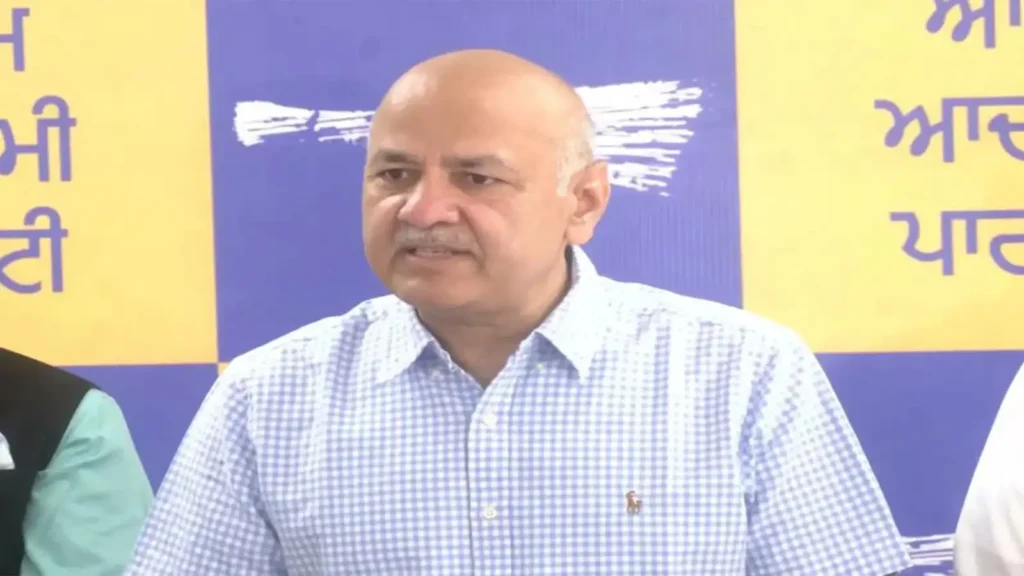
According to AAP’s Punjab in-charge Manish Sisodia, the campaign will involve around 2.68 lakh booth committee members, who will take the party’s message directly to households. The campaign will also include a membership drive.
The outreach comes as the AAP government approaches the end of its current term. The party is seeking to put its performance since taking office in 2022 at the centre of its election campaign.
The statewide campaign also places the AAP’s organisational machinery directly against similar efforts by opposition parties, making grassroots outreach an increasingly visible part of Punjab’s pre-election activity.
BJP focuses campaign on Punjab’s drug issue
The issue of drugs has emerged as one of the major subjects of political discussion in Punjab.
The BJP launched its Nasha Mukt Punjab Yatra on September 18, with four separate yatras beginning from Pathankot, Fatehgarh Sahib, Fazilka and Talwandi Sabo. The campaign is planned to cover approximately 4,000 kilometres and all 117 Assembly constituencies over 13 days.
The campaign is scheduled to conclude in Jalandhar on September 30, where Union Home Minister Amit Shah is expected to participate in the concluding programme.
The BJP has presented the campaign as an effort to raise public awareness about drug abuse and make the issue a central part of its political outreach.
The party has also used the campaign to criticise the AAP government over its handling of the drug problem. Those are political allegations made by the BJP, while the state government has its own record and position on the issue.
The campaign follows a meeting organised by the Punjab BJP in Chandigarh where families affected by drug addiction shared their experiences. The party has sought to turn the issue into a wider public campaign ahead of the election.
AAP and BJP campaigns overlap
The timing of the two campaigns has added another layer to Punjab’s political activity.
The BJP’s anti-drug yatra began on September 18, while the AAP’s statewide door-to-door outreach is scheduled to begin on September 20.
This means both parties will be carrying out large-scale grassroots activity at almost the same time, although their stated campaign objectives are different.
The BJP is placing significant emphasis on the drug issue, while the AAP is focusing on presenting the performance of the Mann government and strengthening its organisation.
The competing campaigns are likely to make public issues and the record of the current government increasingly prominent in Punjab’s political debate.
Congress reorganises its Punjab campaign
The Congress is also preparing for the 2027 election.
Sachin Pilot has recently taken charge as the Congress’s Punjab in-charge. His appointment comes after the party made changes to its organisational leadership in the state as it prepares for another Assembly election.
Pilot has already become involved in the party’s Punjab campaign and organisational activities. Recent reports have also highlighted the party’s decision not to project a chief ministerial candidate at this stage.
The Congress is seeking to strengthen coordination within its state organisation and establish a campaign structure ahead of the election.
The party has also been raising issues related to law and order, social concerns and the functioning of the state government.
The political contest in Punjab is therefore developing around three major organisational efforts: the AAP’s attempt to defend its record, the BJP’s expansion of its state-level campaign and the Congress’s effort to rebuild its electoral organisation.
Punjab’s political issues
Several issues are expected to remain important as campaigning develops.
The drug problem is already receiving significant attention, particularly through the BJP’s statewide yatra.
Government performance is another major issue, with the AAP preparing to take its record directly to voters.
Employment, agriculture, the state’s finances, law and order and public services are also likely to feature in the wider political discussion.
However, the issues that ultimately dominate the election campaign will depend on developments in the months ahead and the priorities that individual parties choose to put before voters.
Uttar Pradesh enters an active pre-election phase
Uttar Pradesh, India’s most populous state, is also moving into a more active political phase ahead of the 2027 Assembly elections.
Political parties have started concentrating on their organisational networks and grassroots presence as the election approaches.
The BJP remains focused on strengthening its organisation and maintaining contact with party workers and local leadership across the state. Recent political reporting has highlighted increased activity by the party’s leadership as it prepares for the election.
The Samajwadi Party is also working on expanding its organisational and social outreach.
Recent reporting indicates that the SP is looking beyond its traditional support base and attempting to strengthen its presence among non-Yadav OBC communities and non-Jatav Dalit groups ahead of the election.
These efforts indicate that social groups and grassroots organisation are likely to be important components of the political strategies of the major parties.
Congress makes organisational change in Uttar Pradesh
The Congress has also made a significant organisational appointment in Uttar Pradesh.
On September 17, the party appointed Kunwar Singh Nishad as chairman of the Uttar Pradesh Congress Committee’s Media and Publicity Department.
The appointment was approved by Congress president Mallikarjun Kharge and is part of the party’s broader organisational preparations for the 2027 election.
Nishad is an experienced political figure and has previously been associated with the BJP before joining Congress. His appointment gives him responsibility for an important part of the party’s communication structure in the state.
The move comes at a time when political parties are increasingly focusing on media outreach, digital communication and direct engagement with voters.
SP-Congress seat-sharing remains a key issue
One of the major questions surrounding Uttar Pradesh politics is the future of the Samajwadi Party-Congress alliance for the 2027 Assembly election.
The two parties worked together during the 2024 Lok Sabha election and have indicated an interest in continuing cooperation in Uttar Pradesh. However, negotiations over seat-sharing have reportedly encountered differences.
Recent reports suggest that the two parties have different expectations regarding the number of constituencies each should contest. Key constituencies, including Rae Bareli and Amethi, have also emerged as points of discussion in the negotiations.
The precise seat-sharing arrangement has not been finalised.
The negotiations will therefore remain an important part of the political developments in Uttar Pradesh as the election approaches.
Youth and employment remain important themes
Young voters are another important part of the political conversation in Uttar Pradesh.
Political parties are seeking to engage students, first-time voters, young workers and people preparing for competitive examinations.
Employment opportunities, recruitment, education, competitive examinations and government jobs are among the subjects that frequently feature in political discussions involving younger voters.
The importance given to these issues is also connected to the state’s large young population and the size of its electorate.
As parties expand their grassroots campaigns, youth-focused outreach is likely to become increasingly visible through meetings, social media campaigns, student engagement and public programmes.
Organisation becomes central to the 2027 preparations
The activities in both Punjab and Uttar Pradesh demonstrate how political parties begin preparing for elections well before the formal announcement of the poll schedule.
In Punjab, parties are already organising statewide campaigns and reaching voters directly.
In Uttar Pradesh, the focus is also on booth-level organisation, leadership appointments, social outreach and alliance negotiations.
The emphasis on organisation reflects the importance of local networks in Assembly elections, where campaigns are conducted across individual constituencies and involve extensive engagement with voters at the grassroots level.
Different political issues in the two states
Although Punjab and Uttar Pradesh are both heading towards Assembly elections in 2027, the political issues being highlighted in the two states are not identical.
In Punjab, the drug problem has emerged as a prominent issue, particularly following the BJP’s 4,000-km anti-drug campaign. The AAP, meanwhile, is concentrating on its government report card and direct household outreach.
In Uttar Pradesh, political activity is more closely linked to organisational expansion, social groups, youth concerns and possible alliances.
The SP-Congress seat-sharing discussions are particularly important because the eventual arrangement could shape how the two parties organise their campaigns across constituencies.
At the same time, the BJP is working on its own organisational preparations as the election approaches.
The road to the 2027 elections
The Assembly elections in both states are still ahead, but the political groundwork has already begun.
Punjab is seeing competing statewide campaigns, with the AAP preparing its door-to-door outreach and the BJP taking its anti-drug campaign across all 117 constituencies.
Congress is simultaneously working on its organisation under its new state in-charge.
In Uttar Pradesh, political parties are focusing on their grassroots structures, community outreach and campaign communication. The Congress’s latest organisational appointment and the continuing SP-Congress seat-sharing discussions are among the latest developments.
The coming months are likely to bring further political meetings, campaign programmes, organisational changes and negotiations between parties.
What to watch in the coming months
Several developments could shape the political environment in both states as the elections approach.
In Punjab, the response to the BJP’s anti-drug campaign, the AAP’s statewide outreach and the Congress’s organisational efforts will be closely watched.
In Uttar Pradesh, the eventual shape of the SP-Congress arrangement will remain an important issue. The BJP’s organisational strategy, the SP’s outreach to different social groups and the Congress’s restructuring will also continue to receive attention.
Political parties are likely to increasingly focus on local issues as the election draws closer, with constituency-level concerns becoming more prominent alongside state-wide themes.
For voters, the coming months will provide a clearer picture of the issues, campaign promises and political alliances that will define the 2027 Assembly elections.
Political activity likely to increase further
The recent developments in Punjab and Uttar Pradesh show that the political groundwork for the 2027 Assembly elections is already underway.
Neither state has reached the formal election campaign period yet, but political parties are expanding their public outreach and strengthening their organisational structures.
Punjab’s political discussion is currently seeing strong attention around drugs, government performance and grassroots campaigning. Uttar Pradesh is witnessing activity around organisation, youth outreach, social groups and the possible continuation of the SP-Congress alliance.
As 2027 approaches, these efforts are likely to become more frequent and more closely connected to constituency-level politics.
For now, both states remain in a pre-election phase, but the growing number of campaigns, organisational appointments and political negotiations indicates that the preparations for the 2027 Assembly elections are already well underway.