

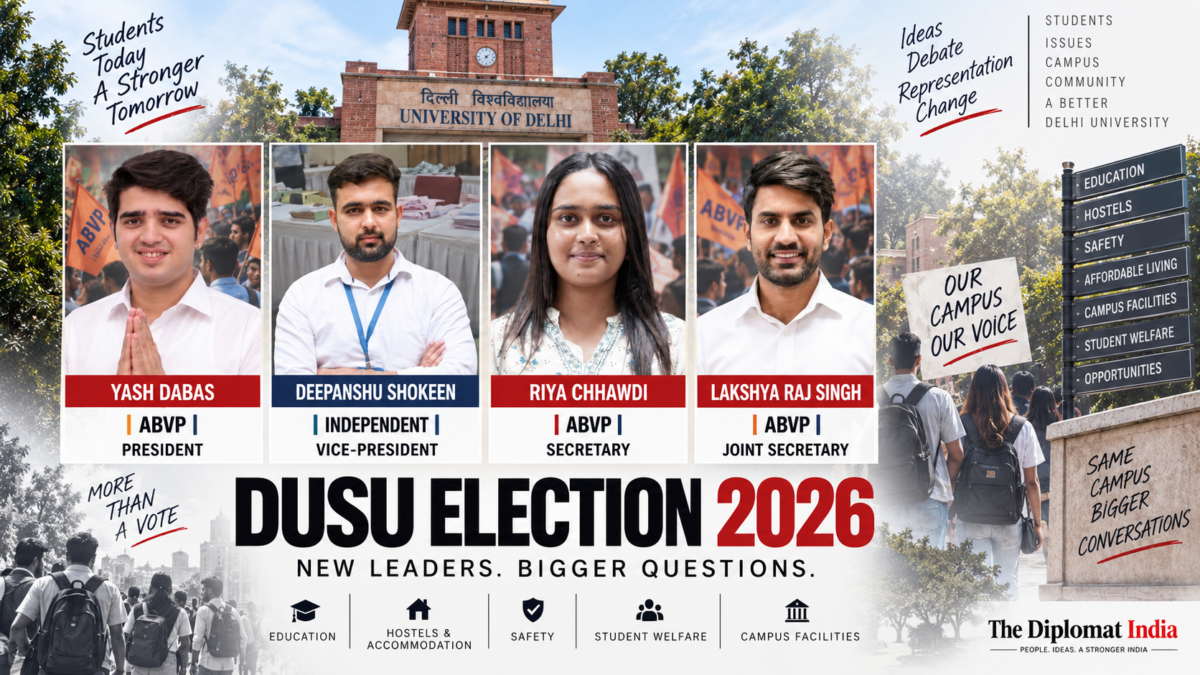
The Delhi University Students’ Union (DUSU) Election 2026 brought student politics, campus safety and accommodation issues into focus as students across the university voted to elect their representatives.
The election was held on September 18, with voting taking place across 52 polling centres. The overall voter turnout was 40.46 per cent, higher than the 39.45 per cent recorded in 2025 and 29.7 per cent in 2024. Electronic voting machines were used for the DUSU polls, with the machines from all polling centres taken to the counting venue after voting.
The results were announced on September 19 after the completion of the counting process. The Akhil Bharatiya Vidyarthi Parishad (ABVP) won three of the four central DUSU posts, while independent candidate Deepanshu Shokeen won the vice-president position.
DUSU Election 2026 Results
ABVP candidate Yash Dabas was elected president of the Delhi University Students’ Union. He secured 24,576 votes and defeated National Students’ Union of India (NSUI) candidate Vijay Shankar Meena by 2,053 votes.
ABVP’s Riya Chhawdi won the secretary post, while Lakshya Raj Singh secured the joint secretary position.
The vice-president post went to independent candidate Deepanshu Shokeen, who secured 30,615 votes. He defeated ABVP candidate Ishu Maurya, who received 16,910 votes. Shokeen’s victory marked the return of an independent candidate to the DUSU central panel after several years.
The final result meant that ABVP secured the president, secretary and joint secretary positions, while the vice-president post went to an independent candidate. NSUI did not win any of the four central posts.
Turnout Increased in 2026
The 2026 DUSU election recorded a 40.46 per cent voter turnout.
According to election data reported after polling, the turnout was higher than the previous two years. In 2025, the turnout was 39.45 per cent, while the 2024 figure stood at 29.7 per cent.
Voting was conducted across Delhi University colleges, with students required to follow identification and entry procedures at polling centres. The university also deployed security arrangements around polling locations.
The use of EVMs was another feature of this year’s election. Officials reported that EVMs from all 52 polling centres were transported to the counting venue after voting ended.
Student Housing and Safety Became Major Election Issues
The election took place only 12 days after the collapse of a private hostel building in Satya Niketan.
The five-storey building collapsed on September 6, killing seven people, including five Delhi University students. The tragedy brought renewed attention to the shortage of affordable university accommodation and the safety conditions in private paying-guest facilities used by students.
Student groups and candidates raised concerns about the availability of hostels, the cost of private accommodation, safety standards and the need for better monitoring of student housing.
The issue was particularly significant because a large number of Delhi University students live outside university hostels. Private accommodation hubs such as Satya Niketan have become important residential areas for students from colleges in South Campus and other parts of the university.
The tragedy therefore became part of the wider election discussion about whether students have access to safe and affordable places to live.
Campus Facilities and Everyday Student Concerns
Apart from accommodation, students raised a range of issues connected with their everyday university experience.
Campus infrastructure, fees, transport, women’s safety, hostel availability and basic facilities featured prominently in discussions around the election. Reports from polling day indicated that many students were looking beyond traditional political affiliations and discussing practical issues affecting their daily lives.
The housing issue also connected with broader concerns about affordability. For students coming from outside Delhi, the cost of rent and other living expenses can form a significant part of their education-related expenditure.
The DUSU election consequently became a platform for candidates and student organisations to put forward proposals concerning student accommodation and safety.
Social Media Changed the Campaign
Social media played an increasingly visible role in the 2026 campaign.
Candidates used Instagram reels, short videos and other online content to reach students, particularly younger voters who spend significant time on social media platforms.
Traditional campaigning, however, remained important. Candidates and their supporters continued to meet students on campus, distribute campaign material and make direct appeals.
The combination of physical campaigning and digital outreach reflected the changing nature of student elections at Delhi University. Candidates could communicate with students online while continuing to rely on face-to-face campaigning across colleges.
Delhi High Court Takes Note of Election Violations
The election was also accompanied by legal concerns over campaign conduct.
The Delhi High Court issued show-cause notices to 140 candidates and student organisations over alleged violations of election guidelines. The court considered whether electoral damages should be imposed in response to repeated alleged violations.
The court also took note of allegations involving the display of weapons, cavalcades of luxury vehicles and other incidents during the election period.
Following the results, the court barred winning candidates from organising victory processions on roads, within the university campus and in hostels.
The proceedings highlighted the continuing debate around the enforcement of election rules in university politics.
The Role of ABVP, NSUI and Other Groups
The 2026 DUSU election featured competition among several student organisations and independent candidates.
ABVP fielded Yash Dabas for president, Ishu Maurya for vice-president, Riya Chhawadi for secretary and Lakshya Raj Singh for joint secretary. NSUI also contested the central panel, while candidates associated with the AISA-SFI alliance and other student groups participated in the election.
The final results produced a different outcome across the four posts. ABVP won three positions, while Deepanshu Shokeen, contesting independently, won the vice-president position.
Shokeen’s victory was notable because he had previously sought an NSUI ticket but entered the election as an independent candidate after not receiving one.
A Different Outcome After a Close Presidential Contest
The presidential contest remained close during the counting process.
During the early rounds, NSUI’s Vijay Shankar Meena and ABVP’s Yash Dabas repeatedly changed positions as counting progressed. At one stage, Meena held a lead, while Dabas later moved ahead.
After the completion of counting, Dabas emerged as the winner with 24,576 votes, while Meena received 22,523 votes. The final margin was 2,053 votes.
The close contest demonstrated the competitiveness of the presidential race despite the eventual three-post majority for ABVP.
Deepanshu Shokeen’s Independent Victory
One of the notable outcomes of the election was the victory of Deepanshu Shokeen in the vice-president contest.
Shokeen secured 30,615 votes, considerably ahead of ABVP’s Ishu Maurya, who received 16,910 votes. NSUI candidate Vir Chatrath finished behind them.
His victory also represented the return of an independent candidate to the DUSU central panel after a long gap. Reports described it as the first independent victory on the central panel since 2009.
The result showed that the four central posts did not necessarily follow the same electoral pattern, with voters choosing candidates from different backgrounds across different positions.
What the DUSU Election Says About Student Politics
The 2026 DUSU election once again showed that student elections involve both organisational politics and everyday campus concerns.
Issues such as accommodation, safety, fees, infrastructure and representation were part of the election discussion. The Satya Niketan tragedy gave particular importance to the question of where students live and whether private accommodation is safe.
At the same time, the election demonstrated the continued importance of established student organisations while also providing space for independent candidates.
The high-profile campaign, increased turnout compared with the previous two years, social media outreach and legal scrutiny made the 2026 election a significant event in Delhi University’s student politics.
What Happens Next
The newly elected representatives will now face the task of addressing the issues raised during the campaign.
Student accommodation and safety are likely to remain important concerns following the Satya Niketan tragedy. Campus facilities, student welfare, fees and representation will also remain part of the responsibilities of the new union.
The Delhi High Court proceedings over alleged campaign violations will continue separately, while the university and student organisations will have to work within the election rules governing future activities.
The DUSU election therefore extends beyond the announcement of the four winners. It represents a continuing process through which students raise concerns about their education, living conditions, safety and participation in university affairs.
The 2026 result has also demonstrated that different groups and independent candidates can receive significant support across different posts, making student representation at Delhi University a diverse and closely contested process.