
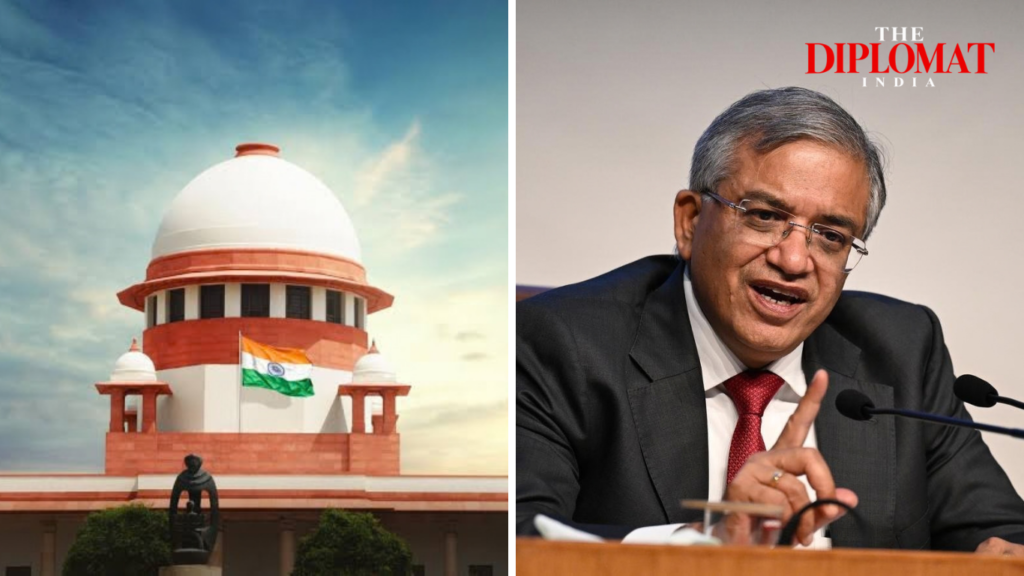
New Delhi, September 29, 2026: The Supreme Court on Tuesday agreed to hear next week a Public Interest Litigation seeking the suspension of Chief Election Commissioner Gyanesh Kumar and questioning the manner in which the Election Commission of India has taken decisions relating to the Special Intensive Revision (SIR) of electoral rolls.
The matter was mentioned before a three-judge bench headed by Chief Justice of India Surya Kant and comprising Justices Joymalya Bagchi and V Mohana. Senior advocate Vikas Singh, appearing for petitioner Rakesh Kumar Singh, sought an early hearing. The Chief Justice said the matter would be listed next week.
The petition questions whether powers vested in the Election Commission as a constitutional body were exercised individually by the Chief Election Commissioner. It relies on Article 324 of the Constitution, which vests the superintendence, direction and control of elections in the Election Commission. Article 324 also provides that when other Election Commissioners are appointed, the CEC acts as the Chairman of the Commission.
The plea further refers to Section 18 of the Chief Election Commissioner and Other Election Commissioners Act, 2023. According to the provision cited in the petition, the Commission should conduct its business unanimously as far as possible, while differences between members are to be decided according to the majority view. The petitioner has argued that decisions attributed to the Commission must therefore comply with the constitutional and statutory framework governing its collective functioning.
The petition was filed by Patna resident Rakesh Kumar Singh. It seeks an interim direction preventing Gyanesh Kumar from performing the functions of Chief Election Commissioner during the pendency of the case. It also asks that the Commission’s business during that period be conducted by Election Commissioners Sukhbir Singh Sandhu and Vivek Joshi, subject to the directions sought before the court.
The plea has been filed against the backdrop of reports concerning differences within the Election Commission during the SIR exercise. The Indian Express reported that Sandhu and Joshi had recorded objections on at least 14 occasions over a period of 10 months concerning decisions and orders related to electoral-roll revision. According to that report, the two commissioners stated that some decisions had been taken without their knowledge or recommendation.
The Election Commission has presented a different account. It has said that differing views and observations are a normal part of institutional deliberations and maintained that its orders carry legal sanction and follow the applicable statutory procedures. The Commission also said that communications by the two Election Commissioners to the Cabinet Secretary concerned an officer on deputation and were not related to policy or Information Technology division matters.
The petition also challenges the legal basis of the nationwide SIR exercise. It asks the Supreme Court to examine whether decisions connected with the revision of electoral rolls were taken in accordance with Article 324 and Section 18 of the 2023 Act. The petitioner has sought a declaration that actions under the SIR which were allegedly undertaken without the required decision of the Commission should be treated as lacking lawful authority.
Another part of the plea seeks a judicial examination of the Election Commission’s original records relating to the disputed decisions. The petitioner has asked the court to determine whether the Commission’s collective powers were exercised in accordance with the constitutional and statutory procedure. The Supreme Court has, at this stage, only agreed to list the matter for hearing next week; no final finding has been made on the allegations raised in the petition.
The forthcoming hearing is expected to consider the petitioner’s challenge concerning the functioning of the Election Commission and the legal process governing decisions of its multi-member structure. The court’s examination will determine the extent to which the issues raised in the plea require further judicial consideration. Read The Diplomat India for more national and legal news.
