

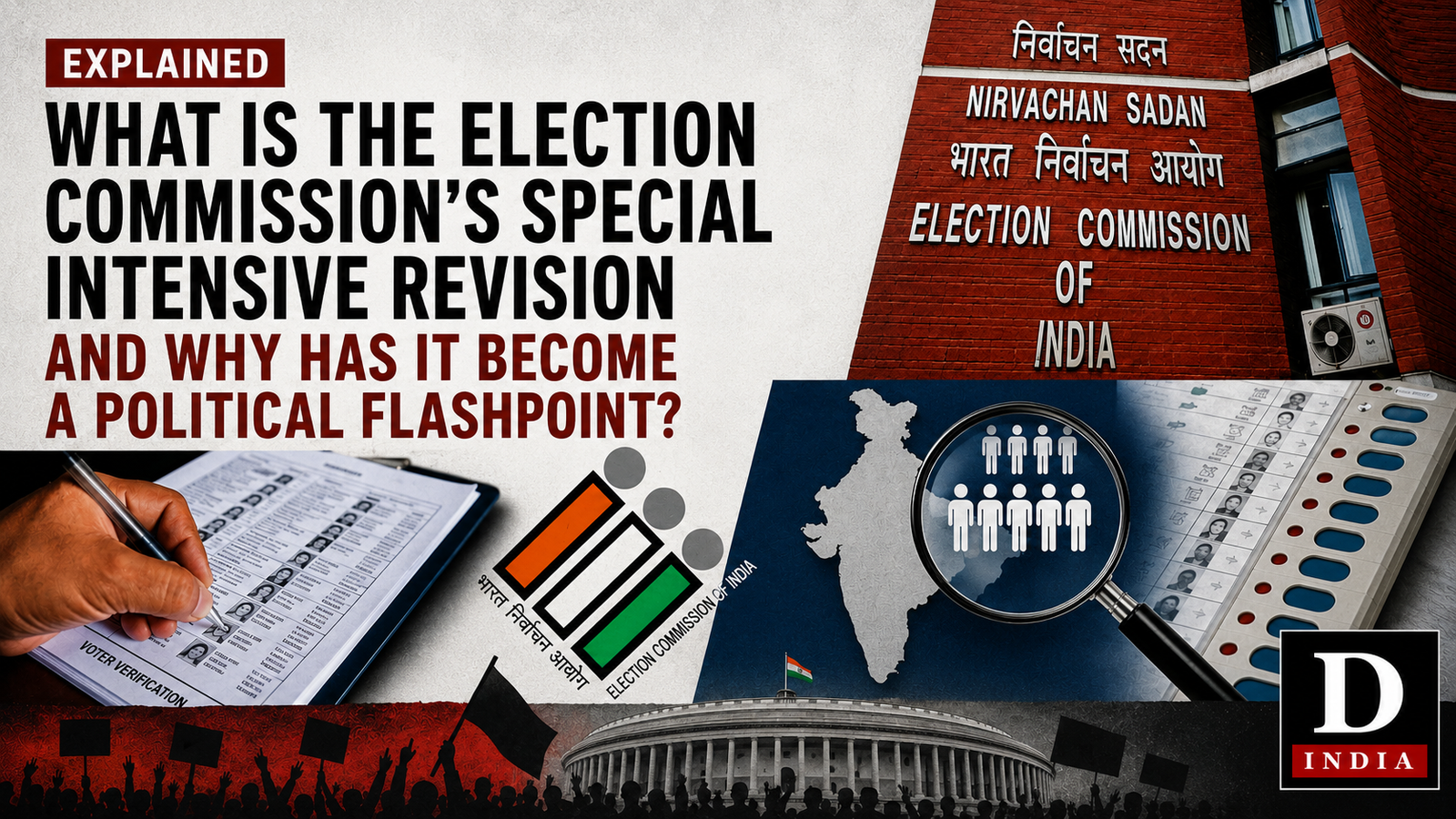
As India updates its electoral rolls, the Election Commission’s Special Intensive Revision has reignited debates over electoral integrity, voter inclusion and institutional trust.
Free and fair elections depend on one fundamental document: the electoral roll. Before every election, the Election Commission of India (ECI) undertakes revisions to ensure that only eligible citizens are registered while removing duplicate, deceased or shifted voters.
This year, however, the Commission’s Special Intensive Revision (SIR) has attracted unusual political attention. As Booth Level Officers (BLOs) begin door-to-door verification across several states, opposition parties have questioned the exercise’s timing and implementation, while the Election Commission maintains that the revision is a routine constitutional responsibility aimed at maintaining clean electoral rolls.
So what exactly is the Special Intensive Revision? Why is it different from routine electoral roll updates? And why has it become one of the most discussed political issues ahead of upcoming elections?
What is the Special Intensive Revision?
The Special Intensive Revision (SIR) is a comprehensive voter verification exercise carried out by the Election Commission of India to improve the accuracy of electoral rolls.
Unlike annual summary revisions, which primarily update voter lists through applications for additions, deletions and corrections, an intensive revision involves field-level verification by election officials. Booth Level Officers visit households, verify elector details and help identify errors that may have accumulated over time. The objective is to ensure that electoral rolls remain accurate, updated and inclusive.
The Election Commission says the exercise seeks to:
- Add newly eligible voters.
- Remove duplicate entries.
- Delete names of deceased voters.
- Update addresses of shifted electors.
- Correct demographic inaccuracies.
- Improve the overall integrity of voter databases.
Why is the exercise taking place now?
According to the Election Commission, the revision is being implemented in phases across different states to prepare updated electoral rolls before future elections.
Several states, including Delhi, Maharashtra, Karnataka, Meghalaya and Jharkhand, have begun the latest phase of the exercise. In Karnataka, for example, officials are conducting door-to-door verification under a phased programme before publishing revised voter lists later in the year.
The Commission argues that increasing urban migration, demographic changes and outdated voter records make periodic intensive revisions necessary.
How does the verification process work?
The process is designed to verify existing records rather than automatically delete voters.
Typically, Booth Level Officers visit residences within their assigned polling areas to verify information already available in electoral records. During these visits, officials may distribute or collect verification forms, update addresses, record changes in family details and identify new eligible voters.
If residents are unavailable during the visit, officials may revisit the location or leave instructions for completing the verification later. Several states also allow portions of the process to be completed through official online portals.
What documents may be required?
Depending on individual circumstances, election officials may request documents to verify identity, residence or age.
These may include:
- Aadhaar (where applicable)
- Passport
- Driving Licence
- Birth certificate
- Other government-issued documents accepted under Election Commission guidelines
Election authorities have repeatedly clarified that document requirements may vary according to individual cases and local instructions. Citizens are advised to follow directions issued by their respective Chief Electoral Officers.
Why has the Special Intensive Revision become politically controversial?
While electoral roll revisions themselves are not new, the present exercise has generated political debate because of its scale, timing and perceived electoral implications.
Opposition parties have raised concerns regarding:
- Possible exclusion of genuine voters.
- Transparency in verification procedures.
- Timing before significant elections.
- Administrative safeguards for vulnerable populations.
- Adequate opportunities for corrections and appeals.
On June 30, leaders from several opposition parties wrote to the Chief Justice of India seeking judicial attention to issues related to the SIR process and broader electoral concerns.
The Election Commission, however, has maintained that the exercise is intended solely to improve electoral accuracy and that established legal procedures exist for objections, corrections and appeals.
What does the Constitution say?
The Election Commission derives its authority primarily from Article 324 of the Constitution of India, which vests the Commission with the superintendence, direction and control of elections.
Electoral roll preparation is further governed by the Representation of the People Act, 1950, along with detailed electoral rules framed under the Act.
These legal provisions empower the Commission to revise electoral rolls periodically to maintain updated voter records.
Why are accurate electoral rolls important?
Electoral rolls determine who can vote.
- Errors in these lists can have significant consequences:
- Eligible citizens may be unable to vote.
- Duplicate registrations may undermine confidence.
- Deceased voters may remain on rolls.
- Migration can create outdated records.
- Administrative mistakes can affect election management.
Because of this, electoral roll revision is considered an essential administrative function in most democracies.
What safeguards exist for voters?
Election law provides mechanisms through which citizens may:
- Verify whether their names appear on the electoral roll.
- Apply for inclusion if omitted.
- Seek correction of inaccurate details.
- Object to wrongful deletions.
- Appeal decisions through prescribed legal procedures.
The Election Commission encourages voters to regularly check their details using official election portals instead of waiting until polling day.
Why does public confidence matter?
Electoral integrity depends not only on accurate voter lists but also on public trust in the institutions conducting elections.
For the Election Commission, maintaining transparent procedures and communicating clearly with citizens are essential to ensuring confidence in the revision process.
For political parties, the exercise is closely watched because electoral rolls can influence campaign planning, voter outreach and election preparedness.
Experts often argue that both objectives—clean voter rolls and protection against wrongful exclusion—must be balanced carefully.
What should voters do?
Citizens can reduce the risk of last-minute problems by:
- Checking whether their name appears on the electoral roll.
- Cooperating with Booth Level Officers during verification.
- Updating any change in address or personal details promptly.
- Responding to official notices, if received.
- Using authorised Election Commission portals for corrections or status checks.
The Bottom Line
The Special Intensive Revision is fundamentally an administrative exercise intended to improve the accuracy of India’s electoral rolls. Yet, because elections are central to democratic legitimacy, even routine verification exercises often acquire political significance.
As the revision progresses across multiple states, much will depend on transparent implementation, effective communication with voters and adherence to due process. Ensuring that every eligible citizen can vote—while maintaining accurate electoral records—remains the shared objective around which India’s electoral system ultimately revolves.