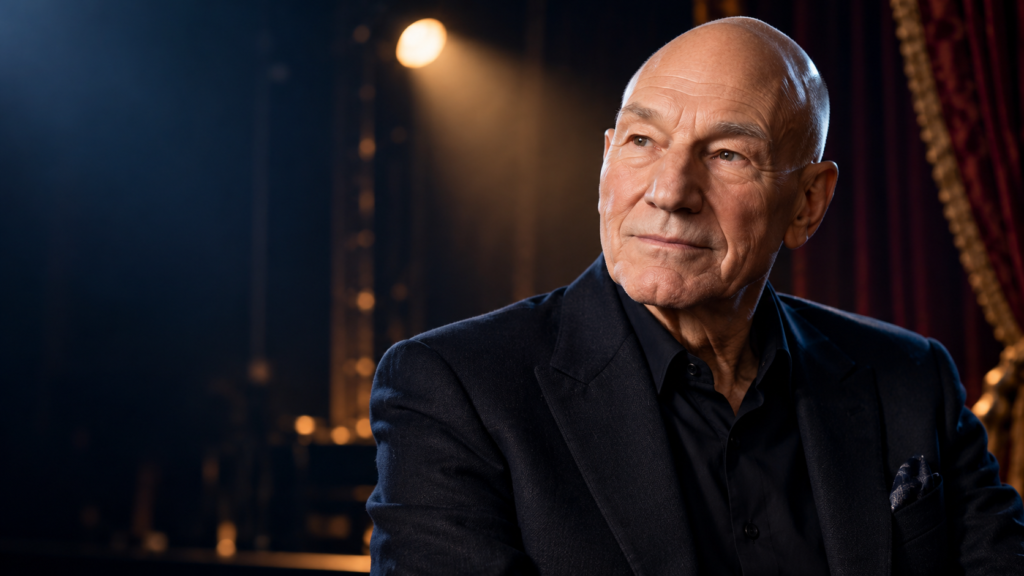
On 28 October 2026, one of screen history’s most recognisable voices fell silent. Sir Patrick Stewart died at his home in Los Angeles, aged 86, after what his representative called “a brief and poignant journey” with Alzheimer’s disease and Lewy body dementia. On 18 December, that voice will be heard again in cinemas worldwide.
Stewart was two characters at once for millions of viewers: Captain Jean-Luc Picard of Star Trek: The Next Generation, the role that brought his breakthrough in 1987, and Professor Charles Xavier, the telepathic teacher of the X-Men films, which he joined in 2000 alongside Sir Ian McKellen. He came to both from the stage. He trained at the Bristol Old Vic and began his professional career with the Royal Shakespeare Company in 1966. Over six decades he earned a Grammy, three Laurence Olivier Awards, a star on the Hollywood Walk of Fame and a knighthood, though never an Oscar.
Tributes dwelt on how human his characters felt. The Academy of Motion Picture Arts and Sciences said he brought “a tenderness” to them. Stewart himself had shown no sign of slowing down. In a July interview marking Star Trek’s 60th anniversary, he said he could not imagine officially retiring: “I’ll always and forever be an actor.” Marvel’s Avengers: Doomsday, directed by Anthony and Joe Russo, opens on 18 December 2026. It brings him back as Professor X for what Deadline counts as the eighth time, and the film’s trailer already features the character. Nothing about this release is controversial. But it puts a question to the law that it has only recently begun to answer: when software can reproduce a performer’s voice and face, who controls them after death?
This article argues that the answer depends on where the performer lived and what they signed. California has a specific statute. The US federal bill has stalled. England has no equivalent right, and Indian courts have held that personality rights end at death. Where the law is silent, contracts and private planning do the work. One simple test runs through the analysis: is the audience watching a real performance by the actor, or a computer-made copy of one?
The law treats the two very differently.
I. Who Controls a Performer After Death?
A. California: two rules, one test
California’s Civil Code section 3344.1 works in two layers. The older layer is about selling. Using a dead celebrity’s name, voice or likeness on merchandise, or to advertise a product or service, requires consent from whoever now holds those rights. Films, television programmes and books are generally exempt, unless something inside them works as a disguised advertisement. That is why a posthumous film release is not, in itself, a legal problem, although merchandise or advertising built on Stewart’s face would be.
The newer layer, added by AB 1836 (signed in September 2024 and effective from 1 January 2025), targets artificial intelligence. It makes a person liable if they produce, distribute or make available a “digital replica” of a deceased personality’s voice or likeness in an audiovisual work or sound recording without consent. Damages are at least $10,000 or the actual loss, whichever is greater. A digital replica is a highly realistic, computer-generated representation, readily identifiable as the person, in which the individual either did not perform or appear, or did, but the fundamental character of the performance was materially altered. There are exceptions for news, comment and criticism, scholarship, satire and parody, genuine documentary or biographical use, and fleeting or incidental uses.
The rights are property that can be left by will, trust or contract. If no one is named, they pass first to the spouse and children and then to the parents. They last 70 years after death. A claimant must register with the Secretary of State before recovering damages for earlier uses, and the statute applies only to acts in California.
Applied to Stewart, the test is straightforward. Real footage of him performing as Professor X is not a digital replica. New scenes generated after his death would be, and would need consent from whoever holds his rights. He died at his Los Angeles home, so California is the natural starting point for his estate, though which state’s law governs depends on where he was legally domiciled, which this article does not try to settle.
B. The federal response: the NO FAKES Act
California’s rule stops at the state line, so Congress is considering a national one. The NO FAKES Act of 2026 (S. 4591) would create a federal property right over a person’s voice and visual likeness. It could not be assigned during the person’s lifetime but could be licensed, and under the bill’s official summary it does not expire on death. Unauthorised distribution of a digital replica would be actionable, a notice-and-takedown system with counter-notices would apply, and news reporting, sports broadcasts and satire would be exempt. The bill would override state laws on digital replicas except causes of action under state statute or common law in existence on 2 January 2025. California’s rule took effect the day before, so it appears to survive, though that is an inference from the dates.
The bill is not law. The Senate Judiciary Committee reportedly approved it unanimously by voice vote on 18 June 2026, but a 7 October 2026 Daily Journal headline described it as “dead for now” after Senator Cruz objected to a unanimous consent request. Until something passes, a performer’s heirs depend on state law.
C. A patchwork across the states
State law does not agree with itself. The Eleventh Circuit in the Martin Luther King case (1983) treated the right of publicity as inheritable property, and the Third Circuit allowed a personal representative to sue under New Jersey law in McFarland v. Miller (1994). The Sixth Circuit went the other way, holding the right did not survive death under Tennessee law in Memphis Development Foundation (1980) and lapsed under Ohio law in Reeves v. United Artists (1985). Groucho Marx Productions (Second Circuit, 1982) held that the law of the person’s domicile at death decides whether the right passes to heirs. For a performer, where he lived at death can decide whether his family has any claim.
D. England
England takes a different route. The Court of Appeal in Fenty v Arcadia Group Brands [2015] EWCA Civ 3 noted that English law recognises no “image right” or “character right” allowing a celebrity to control the use of their name or image. A celebrity must instead rely on another cause of action, such as contract, breach of confidence, copyright or passing off. Rihanna succeeded against Topshop in passing off because buyers were likely to think a T-shirt bearing her image was authorised by her. Irvine v Talksport [2003] EWCA Civ 423 had earlier accepted that implied endorsement can amount to actionable misrepresentation. Passing off protects against misleading consumers. It does not give a performer, or an estate, general control over a likeness.
Statutory performers’ rights are narrow on the point that matters most here. Moral rights for performers, inserted into the Copyright, Designs and Patents Act 1988 in 2006, cover live and broadcast performances and sound recordings. Barristers’ chambers 5RB noted at the time that video recordings were excluded, a limit performers’ organisations criticised. A screen actor therefore has little statutory protection against what is done to a filmed performance.
II. Where the Real Protection Sits: Contracts, Unions and Private Planning
If statute is patchy, protection comes from contracts, and the most important is the agreement between the actors’ union, SAG-AFTRA, and the studios. The idea that a scan needs consent predates the AI debate. The union’s stated position under the 2020 contract was that a digital double made of a background actor on set could be used only for the programme or film for which it was scanned. Use anywhere else needed written consent and payment.
AI then became central to the 118-day actors’ strike of 2023. The resulting contract was built around informed consent and compensation: actors must be told how a studio will use generative AI and be paid for it. The rule reaches beyond death. Where a performer is deceased, an heir or union representative may grant consent, and if no estate representative can be found, the union’s representative can do so. This works much like AB 1836 but travels with the performer to any covered production wherever it is shot.
The union then turned to a different threat. Bargaining for the next contract opened in February 2026, and its priorities included synthetic performers such as Tilly Norwood, an AI creation of the studio Xicoia. IndieWire reported that the union was seeking what had come to be called the “Tilly Tax”: a royalty whenever a studio uses a performer who isn’t real, so a synthetic would never be cheaper than a human. Members ratified the new agreement in June 2026 by 91.42 per cent. It runs from 1 July 2026 to 30 June 2030, and reports say studios may use AI performers only if they bring “significant additional value” over a live actor or their digital avatar, after notifying the union and justifying the choice. The absolute ‘Tilly Tax’ levy was stripped from the final agreement. It was replaced by a strict notice-and-bargaining protocol, requiring studios to provide a 10-day notice and negotiate digital compensation in good faith under penalty of binding union arbitration.
Performers can also protect themselves privately. Robin Williams, who also lived with Lewy body dementia, placed his publicity rights in a trust that barred commercial exploitation for 25 years after his death, until 2039, and gave the rights to a charitable foundation. Commentators noted that it blocked uses such as holograms and digital insertion into advertising and called it a possible model for others. He wrote that rule into his own trust years before AI made the restriction matter.
Back to Doomsday. Stewart’s scenes were filmed, and the trailer shows them, so audiences are watching a real performance. The release triggers neither California’s AI rule nor the union’s replica rules. Questions would arise only if a studio wanted something after his death that he never performed: finishing a scene, altering his dialogue or creating a new appearance. That would be a digital replica, needing consent from his estate or, failing that, from the union. This assumes his work was covered by a SAG-AFTRA agreement, which has not been confirmed, and nothing public shows what his contract or estate plan says. Because principal photography for Doomsday commenced in April 2025, the production is strictly governed by the 2023 SAG-AFTRA Codified Basic Agreement. Its robust protections mandate explicit post-mortem consent from Stewart’s estate or the union before any digital replicas can be deployed.
III. India: Rights That End at Death
India sits at the opposite end from California. It has no statute on posthumous personality rights, and the Delhi High Court has held that, without one, these rights die with the person. In Krishna Kishore Singh v. Sarla A. Saraogi (2023:DHC:4631), the father of the late actor Sushant Singh Rajput sought to stop the streaming of the film Nyay: The Justice. C. Hari Shankar J. watched the film and found it an overt re-enactment of the actor’s life. He called its disclaimer, saying it had nothing to do with real people, “worth tinsel”. The injunction was still refused. The court held that the privacy, publicity and personality rights in question were not heritable and “died with” the actor, so his father could not enforce them, and that any remedy would lie in damages, not an injunction. The damages claim was preserved for trial, and this was a ruling on an interim application.
The court relied on the Madras High Court’s Deepa Jayakumar v. A.L. Vijay (2021), which held that personality rights and reputation earned in life extinguish at death and cannot be inherited like movable or immovable property. That court had in turn drawn on the Supreme Court’s discussion of causes of action in tort, and on section 306 of the Indian Succession Act, 1925, under which a defamation claim does not survive death. The judge was also sceptical of “celebrity rights” as a special bundle for the famous, calling the concept “completely unacceptable” and saying rights flowing from persona belong to everyone. He stressed that ownership of a right is the starting point for any claim, and noted that in Titan Industries v. Ramkumar Jewellers a claim succeeded because the celebrity had assigned his rights by contract.
For living performers, the picture is far stronger. In Anil Kapoor v. Simply Life India (Delhi High Court, 20 September 2023), Pratibha M. Singh J. granted an interim injunction restraining misuse of the actor’s name, image, voice and likeness, including through AI and deepfakes. In Arijit Singh v. Codible Ventures (Bombay High Court, 26 July 2024), Chagla J. granted an ad-interim injunction against entities including AI voice-cloning platforms, which commentators described as the first Indian ruling on AI voice cloning.
The contrast is stark. Protection is strong during life, but on the Delhi and Madras reasoning, the family has none afterwards. In California, an estate could sue over an unauthorised AI recreation. In India, on current authority, it could not rely on a posthumous personality right and would depend on what the performer arranged by contract in life.
Disclaimer: This article is based on publicly available reports and information at the time of publication. Details are subject to verification and may be updated as further information emerges. The views expressed are for informational purposes only.
