

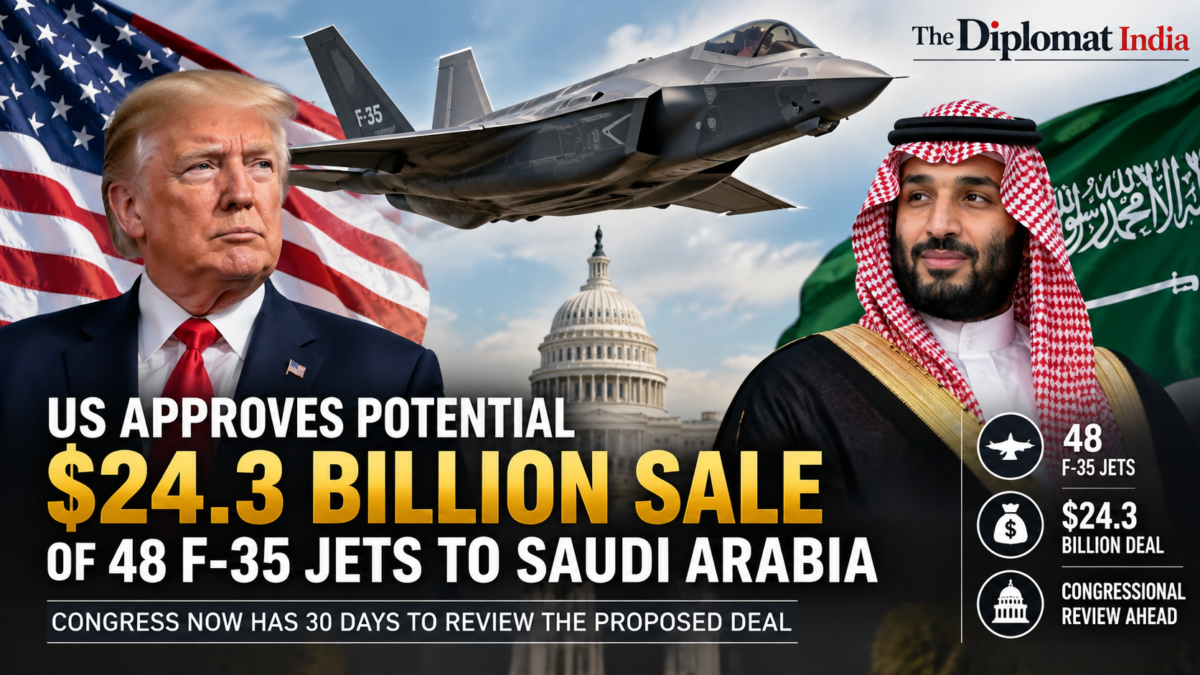
Washington: The United States has taken a major step towards supplying Saudi Arabia with F-35 fighter jets, with the US Department of State approving a potential $24.3 billion sale of 48 F-35 Lightning II aircraft to Riyadh.
The proposed deal, notified to the US Congress on September 17, includes 48 F-35 fighter jets along with 49 Pratt & Whitney F135-PW-100 engines, with 48 engines intended for the aircraft and one designated as a spare. The package also includes associated equipment, training, spare parts, maintenance and logistical support.
The approval represents an important development in the long-running US-Saudi defence relationship. However, the transaction has not yet been finalised. Congress has a 30-day period to review the proposed sale and can seek to block it during that period.
If the sale ultimately proceeds, Saudi Arabia would become the first Arab country to operate the F-35, and the second country in the Middle East after Israel to receive the aircraft.
What is included in the proposed deal?
The proposed Foreign Military Sale covers 48 F-35A Lightning II aircraft, the conventional takeoff and landing version of the aircraft, along with the engines and associated support.
The package is not limited to the fighter jets themselves. It also includes equipment and services needed to operate and maintain the aircraft, including communications systems, spare parts, training and logistical support.
The F-35 is manufactured by Lockheed Martin, while the F135 engines are produced by Pratt & Whitney.
The F-35 is a fifth-generation multirole fighter designed around stealth, advanced sensors, networking and precision strike capabilities. The aircraft is already operated by the United States and several allied countries.
Saudi Arabia has sought access to the F-35 for years as part of its efforts to modernise its armed forces and strengthen its air capabilities.
Congressional review now becomes the next step
Although the State Department has approved the potential sale, the proposed transaction still faces the US congressional review process.
Congress has 30 days to scrutinise the notification and potentially attempt to block the transaction. This means that the State Department’s approval does not automatically translate into an immediate delivery of aircraft to Saudi Arabia.
The congressional review is likely to receive particular attention because the F-35 contains highly sensitive US military technology.
Some American lawmakers have already expressed opposition.
Representative Raja Krishnamoorthi, a Democrat from Illinois and a member of the House Intelligence Committee, criticised the proposed sale on September 17. He cited concerns that sensitive American defence technology could potentially become accessible to China because of Saudi Arabia’s growing relationship with Beijing.
Krishnamoorthi warned that the transfer could put some of America’s most sensitive military technology within the reach of the Chinese government.
His concerns reflect a broader debate in Washington over Saudi Arabia’s defence and economic relationship with China and whether the transfer of advanced American weapons could create technology-security risks.
Concerns over China’s access to sensitive technology
The possibility of Saudi Arabia operating the F-35 has raised questions about the security of the aircraft’s technology.
The concern is linked partly to Saudi Arabia’s expanding relationship with China. Riyadh and Beijing have strengthened their economic and strategic ties in recent years, while Saudi Arabia has also sought to diversify its international partnerships.
Some US lawmakers and defence officials have raised concerns that sensitive technology associated with the F-35 could potentially be exposed to China through Saudi Arabia’s security and technology relationships.
These concerns remain part of the debate over the proposed sale and do not establish that Saudi Arabia intends to transfer American technology to China.
The US has strict controls governing the transfer and use of American-origin defence equipment and technology. Washington can impose end-use and third-party transfer restrictions as part of defence agreements.
The question for Congress will therefore include not only the strategic value of strengthening ties with Saudi Arabia but also how effectively sensitive technology can be protected.
Israel’s military edge is another major issue
The proposed F-35 sale also touches on a longstanding US policy concerning Israel’s qualitative military edge, commonly referred to as QME.
Israel is currently the only country in the Middle East operating the F-35. The country has used the aircraft for years and has developed operational experience with the platform.
US policy requires Washington to take Israel’s qualitative military edge into account when considering major arms sales to countries in the region.
The proposed Saudi sale has therefore raised questions about whether Riyadh’s acquisition of the F-35 could affect Israel’s military advantage.
The State Department, however, said the proposed sale would not alter the military balance in the region. The department said the transaction would support US foreign policy and national security objectives by strengthening the security of a major non-NATO ally and supporting stability and economic progress in the Gulf.
The administration’s position is that the proposed configuration and broader security arrangements can be structured without undermining the US commitment to Israel’s qualitative military edge.
Saudi Arabia could become the first Arab F-35 operator
If the deal receives the necessary approvals and is ultimately completed, Saudi Arabia would become the first Arab state to operate the F-35.
Israel has been the only Middle Eastern operator of the aircraft so far. Saudi Arabia’s acquisition would therefore represent a significant development in the distribution of advanced airpower in the region.
The development would also mark a major expansion of Saudi Arabia’s access to advanced US military technology.
Riyadh has been one of Washington’s largest arms customers for decades, purchasing a wide range of American aircraft, missiles, air-defence systems and other military equipment.
The F-35 would add a new capability to that relationship.
Why Saudi Arabia wants the F-35
Saudi Arabia has been seeking to modernise its military capabilities while responding to a changing security environment in the Gulf and wider Middle East.
The kingdom faces security challenges linked to regional conflicts and tensions involving Iran and Iran-aligned groups.
The renewed security environment has also increased the importance of air defence and advanced aircraft for Gulf states.
Saudi Arabia has already invested heavily in modernising its armed forces, including its air force. The F-35 would provide capabilities that go beyond those offered by many conventional fourth-generation fighter aircraft.
The proposed acquisition is therefore being viewed as part of Riyadh’s broader effort to strengthen its military capabilities and deepen its defence relationship with Washington.
A major development in US-Saudi defence ties
The F-35 proposal comes amid a broader strengthening of relations between Washington and Riyadh under US President Donald Trump.
Trump has maintained a close relationship with Saudi Crown Prince Mohammed bin Salman, and defence cooperation has been an important component of the relationship.
In May 2025, during Trump’s visit to Saudi Arabia, the United States and Saudi Arabia announced a major defence agreement. The White House described the package as worth $142 billion and called it the largest defence sales agreement in history.
The proposed F-35 sale represents another major step in that expanding defence relationship.
The aircraft deal is also part of a wider pattern of American arms sales to Gulf partners as Washington seeks to strengthen its regional security partnerships.
Regional security environment adds urgency
The proposed sale comes at a particularly sensitive moment for the Middle East.
Saudi Arabia has faced security threats from regional conflicts and attacks involving Iran-aligned groups. The broader conflict involving Iran and regional actors has increased concerns among Gulf countries about missile, drone and air threats.
The F-35 sale therefore comes against a backdrop of increased attention to the military capabilities of Gulf states.
The aircraft’s stealth characteristics and advanced sensor systems are among the capabilities that make the platform attractive to countries seeking to strengthen their air forces.
However, the aircraft’s high level of technological sophistication is also one reason the proposed transfer has generated concern among US lawmakers and defence officials.
The US says the sale supports regional stability
The State Department has presented the proposed transaction as part of Washington’s broader security relationship with Saudi Arabia.
According to the department, the sale would support US foreign policy and national security objectives and strengthen the security of a major non-NATO ally.
The department also said Saudi Arabia plays a role in political stability and economic progress in the Gulf region.
At the same time, Washington has stated that the proposed sale would not change the military balance in the region.
The administration’s argument therefore rests on two points: strengthening Saudi Arabia’s defensive capabilities while maintaining the existing regional security framework and the US commitment to Israel’s military edge.
Saudi Arabia welcomes the proposed sale
Saudi Arabia has welcomed the development as another sign of the strength of its defence relationship with Washington.
The Saudi Embassy in the United States described the proposed F-35 sale as a further step in the long-term strategic partnership between the two countries and in their expanding defence cooperation.
For Riyadh, access to the F-35 would represent not only an acquisition of advanced aircraft but also deeper integration with the US defence system.
The proposed purchase could also strengthen military interoperability between Saudi forces and US and allied forces operating in the region.
What happens if Congress objects?
The proposed transaction is now entering a period of congressional scrutiny.
Members of Congress can examine the terms of the sale, including the aircraft configuration, technology safeguards, regional security implications and the potential impact on Israel’s qualitative military edge.
Lawmakers can also introduce measures seeking to block the transaction during the statutory review period.
The fact that objections have already been raised means the congressional process could become an important test for the administration’s plans for deeper defence cooperation with Riyadh.
At this stage, however, the final outcome remains subject to that review process.
A deal with wider geopolitical implications
Beyond the aircraft themselves, the proposed F-35 sale has implications for the wider strategic competition involving the United States, Saudi Arabia, Israel and China.
For Washington, the deal could deepen a longstanding security partnership with one of its most important Gulf partners.
For Riyadh, the acquisition would strengthen its access to one of the world’s most advanced fighter aircraft and could reinforce its military modernisation programme.
For Israel, the central issue is maintaining its qualitative military edge as other regional powers gain access to increasingly advanced weapons.
For US lawmakers and defence officials concerned about China, the key question is whether American military technology can remain secure while Saudi Arabia expands its strategic relationships with Beijing.
These competing considerations are likely to remain at the centre of the congressional debate.
F-35 sale is not yet final
Despite the State Department’s approval, it is important to distinguish between approval of a potential sale and completion of the transaction.
The current development means Washington has formally moved the proposed deal forward and notified Congress. The 30-day congressional review period must now run its course before the transaction can proceed under the applicable process.
Even if the sale ultimately moves forward, the aircraft would not arrive in Saudi Arabia immediately. Production, configuration, training, infrastructure and delivery schedules would all form part of the longer process.
The proposed $24.3 billion package therefore represents the beginning of another stage in the US-Saudi defence relationship rather than an immediate transfer of 48 operational aircraft.
What the deal could mean for the Middle East
If completed, the F-35 sale would mark a significant change in the region’s military landscape by introducing another Middle Eastern operator of the aircraft.
It would also demonstrate the depth of the US-Saudi security partnership at a time when Riyadh is maintaining relationships with both Washington and other major powers.
The sale could have consequences beyond Saudi Arabia’s air force, particularly because advanced military technology plays an important role in regional deterrence and defence planning.
At the same time, the US administration’s assertion that the transaction would not alter the regional military balance indicates that Washington intends to manage the sale within its existing framework for arms transfers to the Middle East.
For now, the next major development will come from Washington, where Congress will examine the proposed transaction during the 30-day review period.
Until that process is completed, the $24.3 billion F-35 package remains a proposed sale rather than a completed arms transfer.
The Diplomat India will continue to follow developments in the US-Saudi defence agreement, the congressional review and its wider implications for security in the Middle East.