

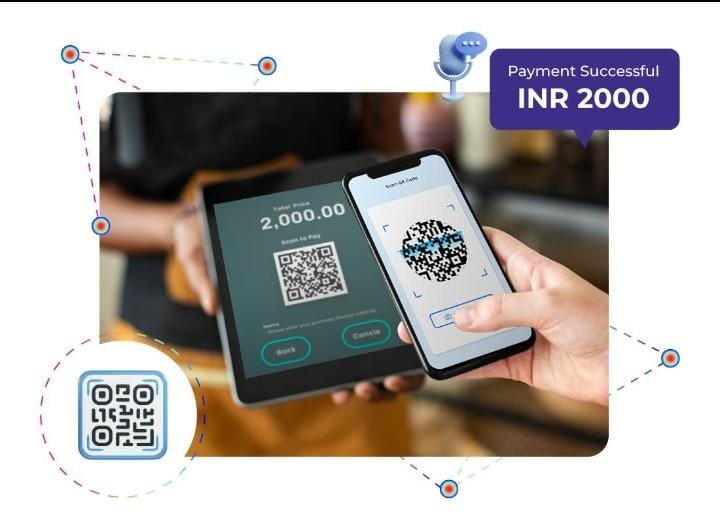
New Delhi: The Centre has moved to provide a clear regulatory safeguard for small-value digital payments, with banks and payment system providers now barred from imposing direct or indirect charges on Unified Payments Interface (UPI) transactions of up to ₹2,000.
The Finance Ministry issued a notification on September 14 under Section 10A of the Payment and Settlement Systems Act, 2007, specifying the electronic payment modes that will remain protected from such charges. The notification covers UPI transactions of up to ₹2,000 and payments made using debit cards powered by RuPay.
Under the new provision, neither the person making a payment nor the person receiving it can be subjected to a charge by a bank or system provider for the specified payment modes. The government has specifically prohibited both direct and indirect charges, effectively preventing banks and payment system providers from recovering such costs through another form of transaction-related fee.
The move is significant for India’s digital payments ecosystem, where UPI has become one of the most widely used methods for everyday transactions. Small-value payments made at shops, restaurants, local businesses and for routine purchases form a substantial part of the country’s digital payment activity.
What the new notification means
The notification does not introduce a charge on UPI. Instead, it formally identifies certain electronic payment modes for which charges cannot be imposed.
For UPI, the protected category covers transactions of up to ₹2,000. RuPay-powered debit card payments have also been included in the notification as a protected electronic mode. The government has therefore drawn a clear regulatory line around small-value UPI transactions while separately protecting RuPay debit card payments.
The wording of the notification is also important because it covers both sides of a transaction. A bank or system provider cannot impose a prohibited charge either on the individual or business making the payment or on the person or entity receiving it.
The measure comes at a time when the government and the payments industry have been discussing the long-term financial sustainability of India’s UPI infrastructure.
Why UPI charges became a subject of debate
The government’s latest notification follows a broader debate over changes to the Payment and Settlement Systems Act, particularly after amendments created a framework under which charges could potentially be introduced for certain digital payment transactions.
The possibility of a Merchant Discount Rate, or MDR, on selected merchant transactions had raised questions among consumers, businesses and payment companies about whether UPI could eventually become a paid service.
The government has sought to distinguish between charges that could potentially apply to certain merchant transactions and the cost faced by ordinary consumers while using UPI.
In its recent clarification, the Finance Ministry said consumers would not be charged for making UPI payments. It also stated that person-to-person, or P2P, UPI transactions would continue to remain free and that there would be no blanket MDR applicable across merchants.
The government has further indicated that any charges introduced for eligible merchant transactions would be significantly lower than the MDR rates generally associated with traditional debit and credit card payments.
The ₹2,000 threshold
The ₹2,000 threshold is particularly relevant because higher-value merchant payments account for a disproportionately large share of UPI’s transaction value, even though they represent a much smaller proportion of transaction volume.
Data cited in recent reporting showed that only around 4 per cent of person-to-merchant UPI transactions in 2025-26 were above ₹2,000, but those transactions represented roughly two-thirds of the total value of P2M UPI payments.
This distinction is important in understanding the government’s approach. The latest notification ensures that small-ticket digital payments remain protected from charges while leaving room for a separate framework for certain higher-value merchant transactions.
For consumers, this means routine UPI payments within the ₹2,000 limit will remain protected under the notification. For the wider payments industry, however, the question of how higher-value merchant transactions will eventually be priced remains relevant.
P2P UPI payments to remain free
Another important part of the government’s position is its treatment of person-to-person transactions.
Payments between individuals, such as transferring money to family members, friends or other individuals, are expected to continue without a charge. The government’s earlier clarification specifically stated that P2P UPI transactions would remain free.
This distinction separates ordinary money transfers between individuals from the merchant side of the UPI ecosystem, where payment service providers and financial institutions have been seeking a sustainable revenue model.
The government has also maintained that there will be no blanket MDR across merchants, suggesting that any future framework would be limited to specified categories or transactions rather than being applied universally.
What is MDR and why does it matter?
Merchant Discount Rate is a fee associated with processing certain digital payments. In a typical card or digital payment transaction, the MDR is distributed among participants involved in processing the payment, including banks and payment service providers.
UPI has historically operated without a conventional MDR for merchants, particularly after the government decided to remove charges to encourage widespread adoption of digital payments.
As UPI usage has expanded dramatically, payment companies and banks have increasingly argued that maintaining the infrastructure requires a sustainable financial model.
The government, meanwhile, has attempted to balance those concerns with its objective of keeping digital payments accessible and affordable.
The latest notification is part of that balancing exercise. It protects small-value UPI payments from charges while allowing the broader discussion around merchant-side pricing to continue.
No immediate charge for ordinary small UPI payments
For consumers, the immediate takeaway is straightforward: a UPI transaction of up to ₹2,000 falls within the category protected from charges under the Finance Ministry’s notification.
The provision also protects payments made using RuPay-powered debit cards from charges covered by the notification. Unlike the UPI provision, the notification does not attach a ₹2,000 ceiling to the RuPay debit card category.
The clarification is expected to reduce uncertainty among UPI users following weeks of discussion around the possibility of charges being introduced on digital payments.
The government’s decision also reinforces its continued emphasis on maintaining low-cost digital payment options as UPI becomes increasingly embedded in India’s retail economy.
The larger picture
India’s digital payments system has expanded rapidly over the past decade, with UPI emerging as a central component of everyday financial transactions. From small purchases at neighbourhood shops to payments made by large businesses, the platform has significantly changed how money moves across the country.
The challenge for policymakers is now to maintain that scale while ensuring that banks, payment companies and technology providers have an economically viable model for operating and expanding the infrastructure.
The latest notification addresses one part of that challenge by guaranteeing that small-value UPI transactions up to ₹2,000 cannot attract charges from banks or system providers.
At the same time, the possibility of a separate MDR framework for selected higher-value merchant transactions means the debate over the future economics of UPI is not over.
For users, however, the immediate message from the government is clear: UPI payments of up to ₹2,000 will remain protected from bank and system-provider charges, while P2P transactions will continue to remain free.
The notification therefore seeks to provide certainty to consumers at a time when questions over the future pricing of India’s most widely used digital payment system had begun to generate considerable concern.
The broader policy objective remains to preserve UPI as an affordable digital payment system while addressing the growing cost of maintaining the infrastructure behind it.