

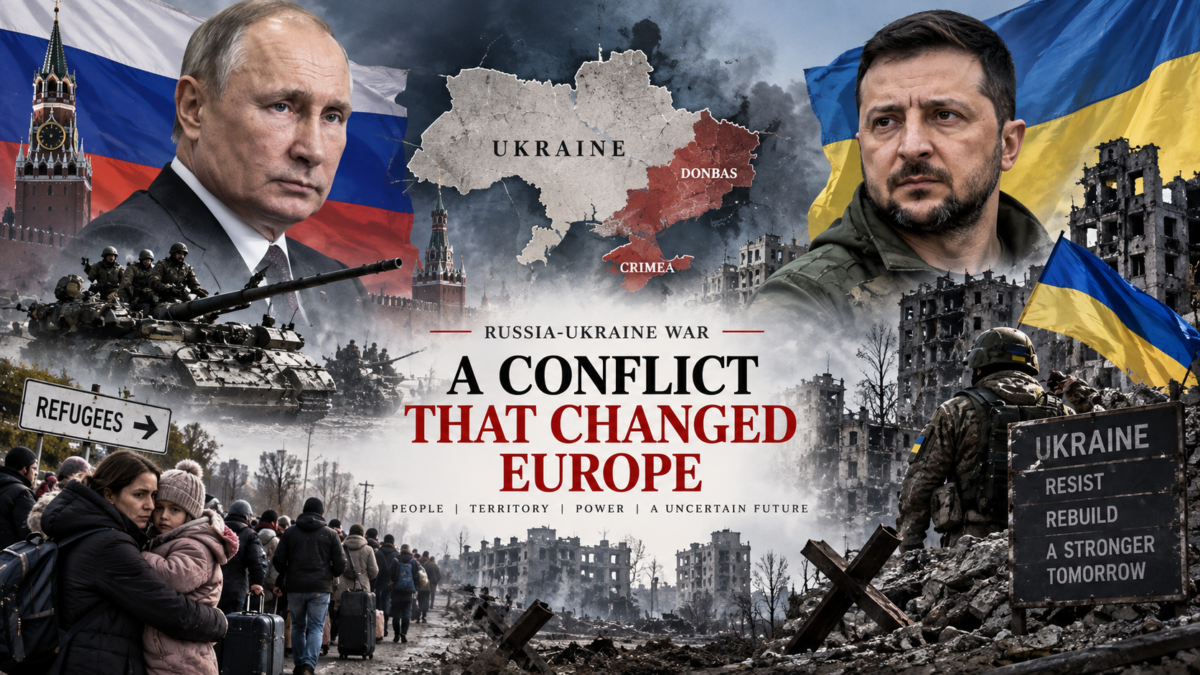
The Russia-Ukraine war is one of the most consequential conflicts in Europe in the 21st century. What began as a political and military crisis in 2014 developed into an eight-year conflict in eastern Ukraine before Russia launched a full-scale invasion on February 24, 2022.
More than four years after the full-scale invasion, fighting continues across Ukraine. Russian forces still control significant parts of Ukrainian territory, while Ukraine continues military operations against Russian positions and infrastructure. At the same time, diplomatic efforts involving the United States, Russia and Ukraine have continued, although major disagreements over territory and security guarantees remain unresolved.
How the Russia-Ukraine Conflict Began
The roots of the present conflict go back to Ukraine’s political crisis in 2014.
After the collapse of the Soviet Union in 1991, Ukraine became an independent country. Ukraine’s later efforts to strengthen ties with European institutions and move closer to the Euro-Atlantic community became an increasingly important issue in its relations with Russia.
In early 2014, Russia took control of Crimea. Russia subsequently annexed the peninsula, a move that Ukraine and the United Nations did not recognise as lawful. The UN General Assembly called on states not to recognise changes to the status of Crimea.
Fighting also began in the Donetsk and Luhansk regions of eastern Ukraine. Armed groups backed by Russia established control over parts of the Donbas, while Ukrainian government forces fought to regain territory.
The conflict continued for eight years before the full-scale invasion in 2022. During this period, ceasefire agreements and diplomatic initiatives, including the Minsk process, failed to produce a lasting settlement.
From Donbas Conflict to Full-Scale War
In February 2022, the situation changed dramatically.
On February 21, Russian President Vladimir Putin recognised the self-proclaimed Donetsk and Luhansk entities as independent and signed agreements with them. Three days later, Russia launched its full-scale invasion of Ukraine.
Russian forces entered Ukraine from several directions, including from Belarus, Russia and Crimea. The fighting quickly spread beyond the Donbas to major cities and regions across the country.
The Ukrainian military resisted the invasion, while Ukrainian civilians also became directly affected by the fighting, bombardment and destruction of infrastructure.
The United Nations has documented extensive civilian harm and has reported findings of war crimes in areas affected by the conflict. Russia has rejected many international allegations concerning its conduct of the war.
Millions of Ukrainians Have Been Displaced
The war has created one of Europe’s largest displacement crises in decades.
According to UNHCR, more than 6.8 million refugees have fled Ukraine since February 2022, while millions of other people remain displaced within the country. At the end of 2025, around 5.2 million Ukrainian refugees were living across Europe.
Many Ukrainians initially crossed into neighbouring countries such as Poland, Romania, Slovakia and Hungary. Others moved further into Europe.
Displacement has affected families, children, elderly people and people who lost homes or livelihoods because of the fighting.
Russia’s Control of Ukrainian Territory
Russia currently controls parts of several Ukrainian regions.
In September 2022, Russia announced the annexation of Donetsk, Luhansk, Kherson and Zaporizhzhia after referendums that Ukraine and much of the international community rejected. Russia does not control all of the territory of those regions.
The United Nations describes these territories as occupied Ukrainian areas and has repeatedly stated that Russia’s attempts to alter Ukraine’s territorial status do not have international legal recognition.
Crimea has remained under Russian control since 2014.
Western Support for Ukraine
The United States, United Kingdom, European countries and other partners have provided Ukraine with military, financial and humanitarian assistance.
Western governments have also imposed extensive sanctions on Russia, targeting individuals, companies, banks, energy revenues and other parts of the Russian economy.
The sanctions have been designed to increase economic pressure on Moscow and restrict Russia’s ability to finance and sustain its war effort.
In September 2026, US President Donald Trump signed a broad Russia sanctions bill that gives the administration additional powers to impose measures targeting Russia and countries purchasing Russian energy.
Russia’s Position
The Russian government has described its military action as a response to what it considers security threats from NATO and Western countries.
Moscow has also argued that the rights of Russian-speaking populations and the situation in Donbas were among the reasons for its military actions.
Ukraine and its Western partners reject Russia’s justification for the invasion and describe the conflict as Russian aggression against Ukraine.
The two sides remain far apart on several central issues, particularly territorial control and future security arrangements.
The Role of NATO
NATO has not entered the war as a direct combatant against Russia.
However, NATO member states have provided significant military assistance to Ukraine and have strengthened their own military preparedness along the alliance’s eastern flank.
Ukraine has also developed closer cooperation with NATO over many years. NATO says its cooperation with Ukraine has included defence capability development, interoperability, reforms and security-sector cooperation.
The question of Ukraine’s future relationship with NATO remains one of the wider strategic issues surrounding the conflict.
Cyberwarfare and Wider Security Risks
The conflict has not been limited to conventional military operations.
Cyberattacks, drone warfare, missile strikes, attacks on infrastructure and maritime incidents have all played a role in the broader confrontation.
The war has also created security concerns beyond Ukraine. European governments have increasingly focused on risks involving sabotage, cyber operations, drones and other forms of hybrid activity connected to Russia.
The conflict has therefore affected European security calculations far beyond the battlefield.
Why Nuclear Weapons Remain a Concern
Russia and the United States are among the world’s largest nuclear powers, making the war particularly sensitive from a global security perspective.
Russian officials have repeatedly referred to Russia’s nuclear deterrent during the conflict. Western governments have also closely monitored Russian nuclear signalling.
A direct confrontation between Russia and NATO is widely regarded as carrying serious escalation risks. However, claims about an imminent Russian nuclear strike should be treated cautiously unless supported by specific evidence.
The nuclear dimension remains one of the reasons the war has consequences far beyond Ukraine.
Peace Talks and Diplomatic Efforts in 2026
Diplomatic efforts have continued despite the ongoing fighting.
In September 2026, US representatives Steve Witkoff and Jared Kushner travelled separately to Russia and Ukraine as Washington attempted to restart negotiations. Ukrainian President Volodymyr Zelenskyy welcomed the renewed diplomatic effort, while Russian officials also indicated that further talks could take place.
However, the September talks did not resolve the central disagreements.
Territorial control remains one of the most difficult issues. Ukraine has rejected demands that would require it to formally surrender territory, while Russia continues to insist on positions that include territorial concessions.
Further trilateral discussions involving the United States, Russia and Ukraine have been proposed for October 2026, although the timing and format remain subject to further agreement.
The War’s Human and Economic Cost
The conflict has caused extensive damage to Ukrainian cities, homes, energy infrastructure, transport networks and industrial facilities.
Millions of people have been displaced, while Ukraine has faced major reconstruction and financing requirements.
The war has also affected global food, energy and commodity markets. Ukraine and Russia are major participants in global agricultural and energy markets, meaning disruptions have consequences well beyond Europe.
European countries have simultaneously faced the challenge of supporting Ukraine while managing energy security, defence spending and the humanitarian needs of displaced Ukrainians.
What Happens Next
The future of the Russia-Ukraine war remains uncertain.
Military operations continue while diplomatic efforts are taking place in parallel. Recent US-led diplomatic activity has created another channel for discussions, but the main disputes over territory, security guarantees and the future political and military relationship between Russia and Ukraine remain unresolved.
The coming months could therefore involve a combination of continued fighting, negotiations, sanctions and international diplomatic pressure.
Any durable settlement would need to address not only the immediate fighting but also questions surrounding territorial control, Ukraine’s security, Russia’s relationship with Europe and the future of occupied Ukrainian territories.
Why the Russia-Ukraine War Matters to the World
The Russia-Ukraine war is not only a conflict between two neighbouring countries.
It has affected European security, international law, global energy markets, food supplies, defence policy and relations between Russia and Western countries.
The conflict has also raised broader questions about territorial sovereignty, military alliances, sanctions and the role of international institutions in resolving major wars.
For Ukraine, the central issue remains its territorial integrity and security. For Russia, the war remains closely connected to its stated security concerns and relationship with the West. For Europe and the United States, the conflict has become a major security and foreign-policy challenge.
As diplomatic efforts continue in 2026, the possibility of negotiations remains, but a lasting settlement will depend on whether the opposing sides can bridge their fundamental differences.