

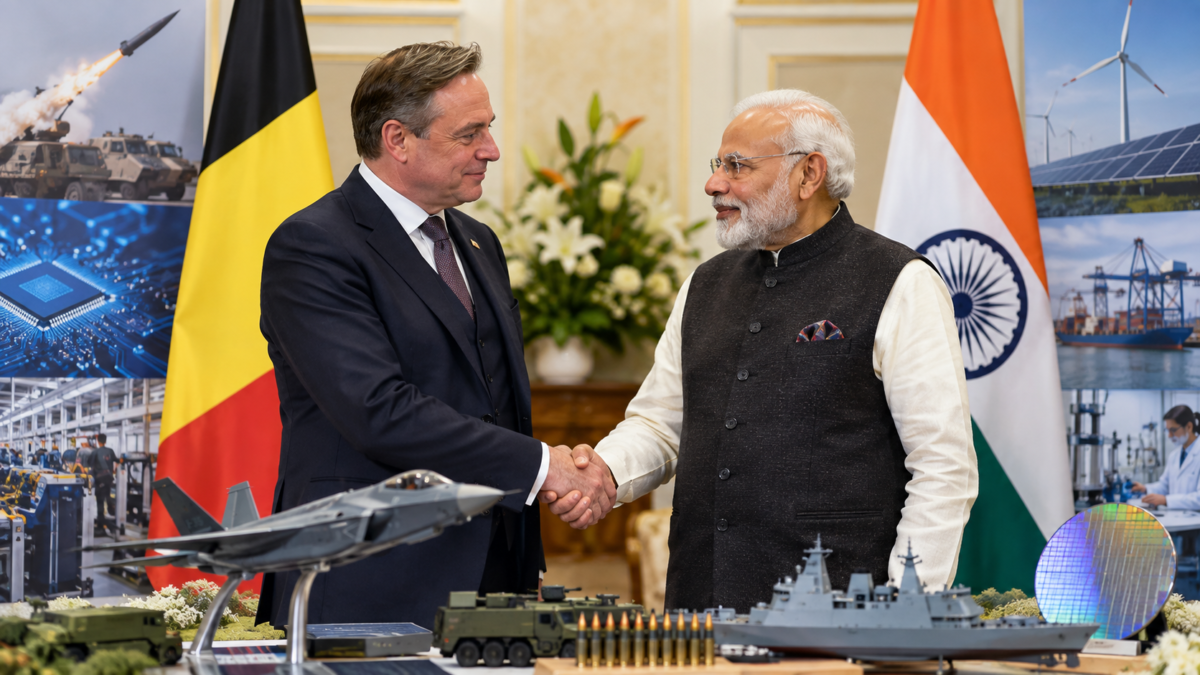
New Delhi: India and Belgium are expanding their bilateral relationship beyond their traditional economic ties, with defence manufacturing, advanced technology, semiconductors, clean energy, investment and industrial cooperation emerging as important areas of the partnership.
The latest push came during Belgian Prime Minister Bart De Wever’s official visit to India from September 2 to 4, 2026, at the invitation of Prime Minister Narendra Modi. De Wever was accompanied by Belgium’s Defence and Foreign Trade Minister Theo Francken, senior officials and business leaders. It was his first visit to India since becoming Belgian Prime Minister in February 2025.
During his visit, De Wever held talks with Modi in New Delhi covering a wide range of issues, including trade, investment, defence, technology, energy, critical minerals and industrial cooperation.
The two governments also backed closer links between companies and institutions from both countries, with several agreements aimed at turning political cooperation into specific industrial projects.
The outcome marks a significant broadening of the India-Belgium relationship. While Belgium has long been an important partner for India in areas such as trade and the diamond industry, the latest agreements put greater emphasis on defence production, technology and strategic supply chains.
Defence emerges as a major pillar
Defence and security have become one of the most prominent areas of the new India-Belgium partnership.
India and Belgium agreed to strengthen defence cooperation through a government-level Letter of Intent, while companies from both countries signed a series of industrial agreements involving ammunition, naval mine-countermeasure systems, rockets, sensors, counter-drone technology and other defence equipment.
The Indian and Belgian defence establishments have also agreed to expand military exchanges, training and capacity-building activities. Defence Minister Rajnath Singh and Belgium’s Defence and Foreign Trade Minister Theo Francken discussed strengthening the institutional framework for cooperation and highlighted the importance of maritime security in the Indo-Pacific.
The industrial agreements are particularly significant because they focus on co-development, co-production and manufacturing in India rather than being limited to conventional equipment purchases.
The Belgian side brought a delegation of defence companies to India, with the two countries identifying opportunities to connect Belgian technology and expertise with India’s growing defence manufacturing capabilities.
Ammunition manufacturing project worth €50 million
One of the largest industrial projects announced during the visit involves Belgian machinery manufacturer New Lachaussée and India’s Tembo Classic Engineering.
Under the agreement, New Lachaussée will supply a complete production line for two ammunition calibres and tooling for two additional calibres.
The proposed facility is expected to have a production capacity of approximately 100 million rounds a year once installed. The project is valued at around €50 million, with deliveries and installation planned for 2028 and 2029.
The project is significant from an industrial perspective because it involves establishing manufacturing infrastructure rather than simply importing finished ammunition.
It also creates a pathway for Belgian industrial technology to be integrated with India’s domestic manufacturing ecosystem.
The companies are expected to work together on production infrastructure, maintenance, spare parts and future modernisation of the equipment.
Naval mine-countermeasure cooperation
Maritime security is another important component of the new partnership.
Belgian company Exail Belgium and Indian engineering major Larsen & Toubro have entered into an agreement connected with India’s mine-countermeasure vessel programme.
Under the arrangement, Exail will provide autonomous systems designed to detect, identify and neutralise naval mines. Larsen & Toubro is involved in the construction of the mine-countermeasure vessels.
The first phase of the programme covers 12 vessels, while the requirement could eventually expand to as many as 59 vessels.
The cooperation is particularly relevant to maritime security because mine warfare can pose a serious challenge to naval operations and commercial shipping.
The partnership also reflects the increasing importance being given to autonomous systems and underwater technologies in modern naval operations.
70mm rocket production to come to India
Another major industrial agreement involves Thales Belgium and Kalyani Strategic Systems for the local production of 70mm rockets.
The agreement is intended to establish production capacity in India, with the first rocket produced entirely in India expected in early 2027, according to Belgian defence officials.
The arrangement is designed to provide India with greater domestic manufacturing capability while giving Thales an additional production source for international requirements.
The partnership therefore has implications beyond the Indian market, with the Belgian side also seeing potential benefits for its wider supply chain.
The agreement is another example of the two countries’ emphasis on manufacturing and industrial cooperation rather than a purely buyer-seller relationship.
Cooperation extends to tanks, sensors and counter-drone systems
The defence cooperation announced during the visit extends beyond ammunition and rockets.
Indian and Belgian companies are also working together on several other technologies.
Belgian defence company John Cockerill Defense is involved in discussions and industrial cooperation related to turrets for India’s Zorawar light tank programme. The Zorawar is being developed for high-altitude operations, and the Belgian company has already been associated with the turret fitted on the DRDO-L&T prototypes.
Another partnership involves Belgium’s OIP Sensor Systems and India’s India Optel Limited. The cooperation covers electro-optical systems, including technology relevant to India’s armoured platforms. OIP has previously supplied sights for the Arjun Mk I tank.
Belgian companies are also involved in counter-drone and autonomous systems.
These projects show that the defence relationship is broadening into areas such as sensors, autonomous platforms, precision systems and electronic technologies.
Belgium and India look towards semiconductors
Defence is not the only strategic technology area receiving attention.
India and Belgium have also identified semiconductors as an important area for cooperation.
The two sides want to deepen connections between companies, research institutions, universities and technology organisations working in the semiconductor ecosystem.
Belgium has a strong research and technology base in advanced semiconductor development, while India is seeking to expand its domestic semiconductor manufacturing and design capabilities.
Greater cooperation between the two ecosystems could support research, technology development, talent exchange and more resilient supply chains.
The semiconductor discussion also fits into the broader effort by India and its international partners to diversify technology supply chains amid growing global competition over advanced technologies.
Critical minerals and strategic supply chains
Critical minerals have also become part of the India-Belgium economic agenda.
Both countries are looking at ways to strengthen cooperation around important industrial inputs and supply chains.
Critical minerals are increasingly important for sectors such as electronics, batteries, renewable energy, electric mobility, aerospace and defence.
For India, building reliable supply chains for these materials is an important part of its broader industrial strategy.
For Belgium and the European Union, partnerships with major manufacturing economies such as India can contribute to diversification and resilience in global supply networks.
The inclusion of critical minerals in the bilateral agenda therefore expands the relationship into an area that has growing strategic importance for both economies.
Renewable energy cooperation gets a fresh push
India and Belgium have also renewed their cooperation in the energy sector.
The two countries signed a Memorandum of Understanding on Renewable Energy, covering areas including hydrogen, solar energy, energy storage and offshore wind.
The framework also covers bio-energy, hydropower and pumped-storage projects.
The agreement is intended to encourage cooperation in clean-energy technologies and create opportunities for companies and institutions from both countries to work together.
For India, cooperation in renewable energy is linked to its broader energy-transition objectives, while Belgium and the wider European market are also investing in low-carbon technologies and energy security.
The partnership could therefore provide opportunities for cooperation in technology, research, investment and industrial development.
Pharmaceuticals, chemicals and life sciences
The bilateral discussions also covered several areas beyond energy and defence.
India and Belgium identified pharmaceuticals, chemicals, life sciences and healthcare as areas with potential for greater cooperation.
Belgium has an established pharmaceutical and life-sciences industry, while India has a major pharmaceutical manufacturing and research base.
Closer cooperation could create opportunities for investment, research partnerships, technology development and supply-chain integration.
The two countries are also looking at opportunities in advanced manufacturing and other technology-intensive industries.
Investment Fast-Track Mechanism launched
Investment cooperation received another boost through the launch of an Investment Fast-Track Mechanism.
The mechanism is intended to help businesses address investment-related issues and facilitate smoother engagement between investors and government authorities.
It will cover investments flowing in both directions, including Belgian investments in India and Indian investments in Belgium.
The two countries also want stronger cooperation between their investment institutions.
The mechanism is designed to make it easier for businesses to navigate issues that can delay investment projects and to create a more structured channel for addressing investor concerns.
India and Belgium target higher bilateral trade
Trade remains an important part of the relationship.
India and Belgium have set an objective of doubling bilateral trade over the next five years, according to the outcomes of the September talks.
The target comes as India and the European Union move towards a broader economic relationship.
The India-EU trade agreement is expected to create additional opportunities for companies operating across the two markets, while the two governments are also seeking to strengthen supply chains in strategic sectors.
Greater industrial cooperation between India and Belgium could therefore contribute to the wider India-EU economic relationship.
Business-to-business cooperation takes centre stage
A notable feature of the latest engagement is the emphasis on direct cooperation between companies.
The official outcomes from the visit include multiple defence-industry agreements, as well as the institutionalisation of the India-Belgium Business Forum.
This approach gives private companies and industrial groups a more prominent role in implementing the broader political commitments made by the two governments.
The objective is to convert bilateral agreements into projects involving manufacturing, technology transfer, research and investment.
For Indian companies, Belgian partnerships can provide access to specialised technologies and European industrial expertise.
For Belgian companies, India’s large domestic market and expanding manufacturing base offer opportunities for production, investment and access to wider international markets.
Cooperation in research and higher education
The partnership also includes efforts to strengthen connections between universities, research institutions and technology organisations.
Such links can support joint research, talent mobility and technology development.
The focus on research is particularly relevant to sectors such as semiconductors, healthcare, clean energy and advanced manufacturing, where collaboration between industry and academic institutions can accelerate innovation.
The two countries have also agreed to strengthen cooperation in diplomatic training, while broader institutional links are being expanded.
Security cooperation extends beyond defence
India and Belgium are also strengthening cooperation in areas related to law enforcement and transnational crime.
A memorandum between India’s Central Bureau of Investigation and the Belgian Federal Police covers cooperation against transnational organised crime, cybercrime and related matters.
This adds another dimension to the relationship at a time when cybercrime and cross-border criminal networks have become increasingly important security concerns.
The two countries have also agreed to continue discussions on consular matters.
From traditional trade to a wider strategic partnership
For decades, India-Belgium relations have been strongly associated with trade, particularly the diamond industry.
The latest agreements indicate that the relationship is becoming considerably broader.
Defence manufacturing, semiconductors, renewable energy, critical minerals, pharmaceuticals, chemicals, logistics, ports and advanced manufacturing are now part of the bilateral agenda.
This shift reflects changes in the global economic and security environment.
India is seeking stronger domestic manufacturing capabilities and diversified international supply chains, while Belgium is looking to deepen economic and strategic partnerships beyond Europe.
The two countries therefore have overlapping interests in building more resilient industrial networks.
Why the defence agreements matter
The defence agreements are particularly significant because they focus on manufacturing and technology cooperation.
Instead of limiting cooperation to the purchase of finished defence equipment, several of the new arrangements involve production facilities, local assembly, technology and industrial partnerships.
The ammunition project, for example, involves establishing a production line in India.
The 70mm rocket arrangement focuses on local production.
The Exail-L&T partnership involves integrating Belgian autonomous mine-countermeasure technology with India’s shipbuilding capabilities.
Other agreements cover sensors, counter-drone systems, turrets and related defence technologies.
Together, these projects create a broader industrial framework for defence cooperation.
A partnership with implications for the Indo-Pacific
The growing defence relationship also comes against the backdrop of India’s increasing focus on maritime security in the Indo-Pacific.
During discussions between the two defence ministers, India and Belgium acknowledged the importance of maritime security cooperation in the region.
Belgium’s involvement in mine-countermeasure technology and autonomous maritime systems provides an area where European expertise can complement India’s naval manufacturing capabilities.
The cooperation also reflects a broader European interest in developments in the Indo-Pacific and India’s growing role in regional security.
What comes next?
The agreements announced during the September visit will now have to move from announcements to implementation.
For defence projects, that means establishing production facilities, completing technology arrangements, integrating systems and meeting delivery schedules.
For semiconductors, clean energy and advanced manufacturing, the next stage will involve identifying specific projects, investment opportunities and research partnerships.
The Investment Fast-Track Mechanism is also expected to provide a channel for companies to address investment-related issues as bilateral economic activity expands.
The goal of doubling bilateral trade within five years provides an additional benchmark against which the partnership will be measured.
India-Belgium ties enter a new phase
The September 2026 visit has given India-Belgium relations a broader industrial and strategic dimension.
Defence cooperation is emerging as one of the most visible components, with projects covering ammunition, rockets, naval mine-countermeasure systems, sensors, light-tank systems and counter-drone technologies.
At the same time, the two countries are building cooperation in semiconductors, pharmaceuticals, clean energy, critical minerals, research, investment and advanced manufacturing.
The agreements do not represent a single project or a single sector. Instead, they form part of a wider effort to connect Indian manufacturing capacity with Belgian technology and industrial expertise.
The success of the partnership will ultimately depend on how effectively these agreements are implemented and converted into long-term commercial, technological and manufacturing projects.
For India and Belgium, however, the direction is clear: bilateral ties are expanding beyond their traditional economic foundations towards a wider partnership built around defence, technology, manufacturing, investment and strategic supply chains.
Read The Diplomat India for the latest news and updates.